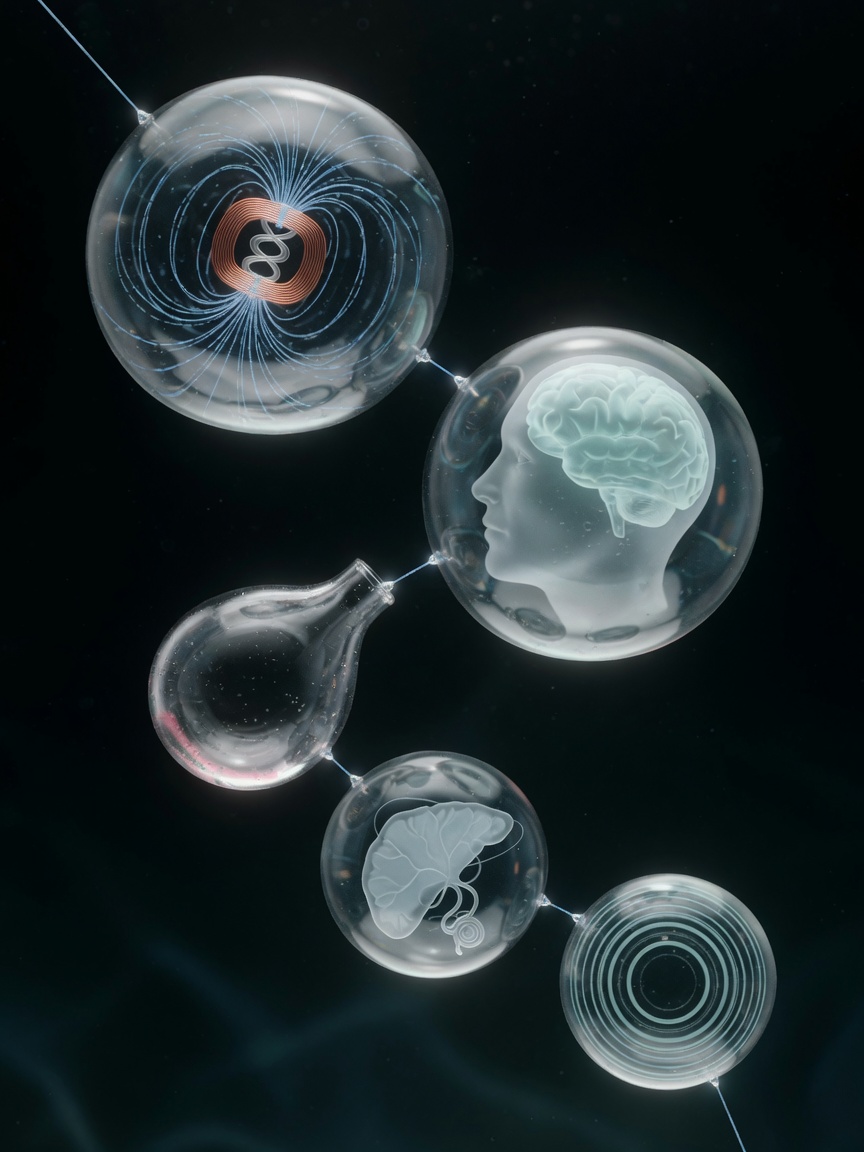


Placenta
SSRIs cross — systemic by design
Perinatal TMS | Paradigm Psychiatry

No drug in blood.
No drug in milk.
No molecule for the placenta.
TMS is not better because it has more pregnancy RCTs than SSRIs. It doesn’t. It’s better because there is no evidence of fetal harm and no evidence of fetal disturbance at all.
Educational information only — not medical advice. Do not stop medication without your clinician.
The interrupt
Not anti-treatment. Anti-blind fetal exposure.

When perinatal depression is recognized, the conversation often jumps to a medication whose risk language is comparative — safer than untreated illness, safer than older agents, “acceptable” in pregnancy tables.
Comparative risk is not the same as no systemic molecule reaching the fetus.
Placenta
SSRIs cross — systemic by design
PPHN
Persistent pulmonary hypertension of the newborn — documented association in some exposures
Neonatal
Neonatal adaptation syndrome — documented with late-pregnancy SSRI exposure
Proof is not panic. It’s precision about what enters the fetal compartment.
Second spike
First Principles
Systemic exposure is not limited to antidepressants. Emerging research has reported detection of vaccine mRNA and related lipid nanoparticle components in placental tissue and cord blood in some samples — an educational signal that what we call “routine” can still be non-zero disturbance at the maternal–fetal interface.
That literature is evolving. It is not a conspiracy frame and not a directive about vaccination decisions. It is a first-principles reminder: if the standard is zero fetal disturbance, systemic agents deserve that scrutiny — including the ones labeled “safe enough.”
Individual situations vary. Decisions belong with you, your OB, and your psychiatrist — with eyes open.
The reframe
It’s winning on no evidence of harm — and no evidence of fetal disturbance. At all.
Not this claim
False frame. Medication trials in pregnancy outnumber neuromodulation trials. Honesty requires saying so.
This claim
Magnetic pulses at the scalp. Nothing enters blood, milk, or placenta. The fetal compartment is not asked to metabolize a molecule.
The standard
When depression must be treated, ask whether the instrument itself introduces fetal exposure — or leaves it optional.
Depression is real. Fetal exposure is optional.
Mechanism stack
TMS stimulation
Loading video…
Focused magnetic pulses. Awake. Nothing enters the bloodstream.
The instrument stays at the scalp. Blood, milk, and placenta are never asked to carry a drug.
Zero-disturbance stack · from pulse to local field
TMS pulses
Focused magnetic pulses at the scalp. You sit awake. Nothing enters the body.
No drug in blood
Non-pharmacological. There is no circulating antidepressant for the placenta to transfer.
No drug in milk
Postpartum and breastfeeding: this modality does not put a medication molecule into milk.
No molecule for the placenta
The fetal compartment is not a second patient on your prescription.
Scalp. Local. Done.
Brief in-office sessions. You drive yourself home. Temporary scalp sensation or mild headache at most — not systemic side effects.
Candidacy



Do not stop medication without a clinician. Untreated perinatal depression carries risk. The consult sorts options — including whether TMS belongs alongside or instead of pharmacologic care.
Your physician
Pranav M. Jagtap, MD is an ABPN-certified psychiatrist with extensive psychopharmacology knowledge. He has studied neuroimaging, brain networks, and brain stimulation modalities since 2011, published research on Sustained Attention, and brings 5+ years of clinical TMS experience — delivered in a personalized fashion at Paradigm Psychiatry.
FAQ
TMS is FDA-cleared for major depressive disorder and other labeled indications. We do not claim a special “FDA-cleared for pregnancy” designation on this page. Perinatal use is a clinical decision after evaluation — treating depression with a modality that does not introduce a systemic drug — coordinated with your OB when appropriate.
No. Do not stop or change psychiatric medication without your clinician. Individual situations vary. Abrupt discontinuation can be harmful. Ask whether perinatal TMS belongs in a planned, supervised conversation with psychiatry and obstetrics.
That comparative claim can be true in many cases — and still leave fetal exposure non-zero. This page asks a narrower question: is there an instrument that treats the depression circuit without presenting a drug molecule to blood, milk, or placenta? That is the zero-disturbance frame.
Insurance-covered TMS often requires documented medication trials and meets criteria for labeled indications such as treatment-resistant depression. Perinatal timing and coverage vary by plan. Brain Fitness with TMS and other cash-pay pathways may apply when insurance criteria are not the right frame. We sort this on intake.
Only a clinical evaluation can answer that. Call 947-209-5202 or request intake below. One conversation — a clear next step, no scare-sell.
Next step
One conversation. Whether perinatal TMS fits — and how it sits with the OB and psychiatry care you already have. Not anti-treatment. Anti-blind fetal exposure.
Paradigm PsychiatryEducational information only — not medical advice. TMS candidacy requires clinical evaluation. Individual results vary. Do not stop or change psychiatric medication without consulting your clinician. Perinatal decisions should involve your obstetric and psychiatric clinicians. TMS is FDA-cleared for major depressive disorder and other labeled indications; this page does not claim FDA clearance specifically for pregnancy. If you are in crisis, call or text 988.