






Call 947-209-5202

Nervous System Regulation | Paradigm Psychiatry

The reaction arrives before you do.

Person in quiet half-light, already braced before the mind has decided how to respond

Heart racing. Tight shoulders. Shallow breath. Your mind is still deciding what to do, and your body has already chosen. That isn’t weak willpower. It’s how a nervous system works when it stays stuck in “danger” mode.

  • ABPN-certified psychiatrist
  • TMS clinical experience 5+ years
  • Franklin, MI

The cost

Staying on guard burns through your day

If part of you is always checking for what might go wrong, that never really “clocks out.” You can finish the workday, sit on the couch, and still feel wrung out — even when nothing dramatic happened.

What’s left over is what you have for focus, patience, sleep, and being present with people. When those feel hard, it often isn’t because you need more tips. It’s because the tank was already empty.

Person alone at a kitchen table at dusk, worn down after a day of constant scanning

Try this

A short attention check

When you’re on high alert, it’s hard to stay with one simple thing. Your mind keeps looking around for problems. This 30-second exercise is just a snapshot of right now — not a diagnosis.

How the nervous system shapes attention

When the system is dysregulated, attention breaks into short, unstable bursts. When it’s regulated, attention can hold as a steadier line.

Press space (or tap) only when you see X. Skip every other letter.

X Respond — spacebar or tap
A–W Do nothing

Educational only — not a medical diagnosis or clinical CPT substitute. Results reflect this moment (sleep, stress, and environment all matter). No email required to start — after the run you’ll see a qualitative read; email unlocks the full report on this page.

What you get back

When the body can stand down

You’re not looking for a new personality. You’re looking for room to live in your own day again.

Person present and at ease in a living room
Person sleeping calmly
  • A pause

    A little more time between what happens and how you react — enough to choose, not just fire.

  • Presence

    Being with the people in the room, instead of watching the exits.

  • Focus

    Attention left over for the task in front of you — not all spent on threat-checking.

  • Coming back down

    After stress, the body settles again in a normal amount of time, instead of staying revved.

  • Sleep

    Easier rest when the day finally ends — not another project you have to force.

Curious whether this fits your system?

How TMS fits

TMS stimulation

Loading video…

Focused pulses at the front of the brain. You sit awake; nothing enters the body. Painless · Non-invasive · Personalized plan

Where the pulses go

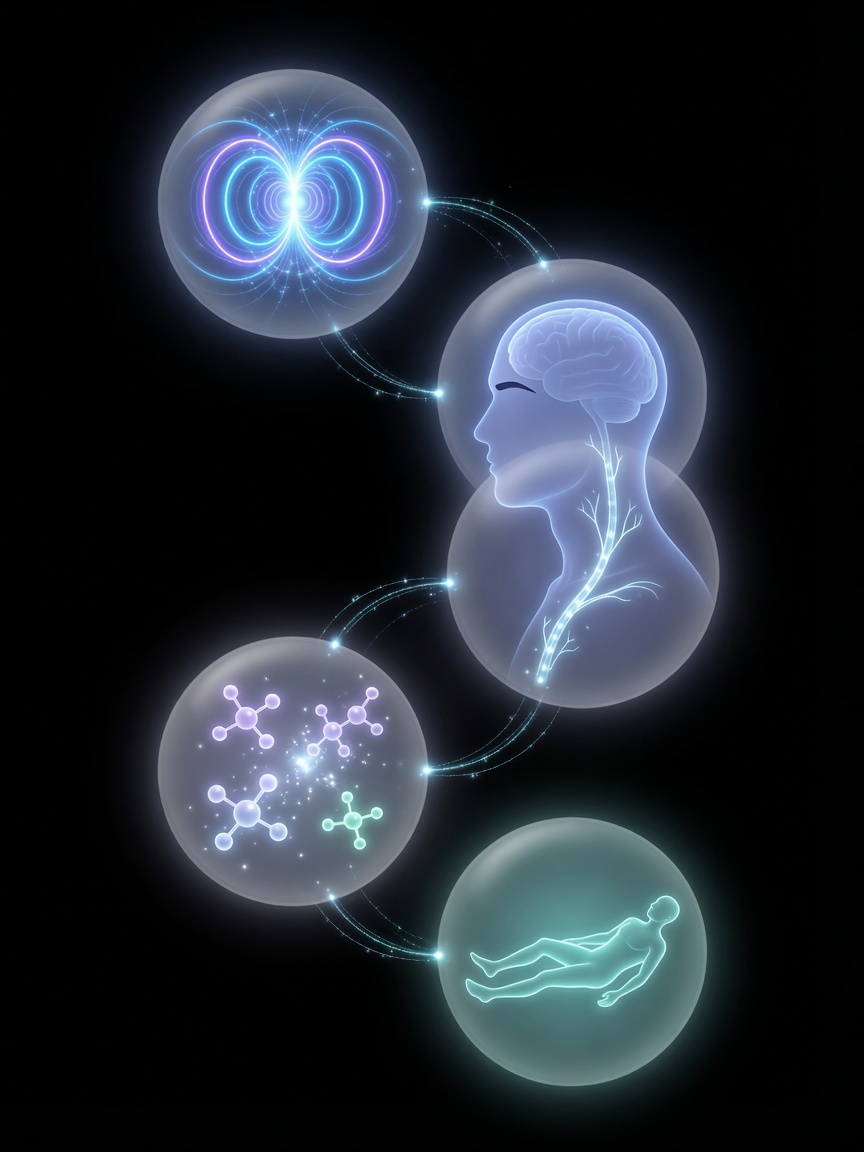
Research on the frontal–vagal network maps a clear chain: prefrontal stimulation → vagus → parasympathetic rest mode. The picture below is a plain-language walk through that network.

Frontal–vagal pathway · from pulse to rest mode

  1. 1

    TMS pulses

    Focused magnetic pulses — painless, non-invasive. Nothing enters the body.

  2. 2

    Prefrontal cortex

    Aimed at the front of the brain — a key node in the frontal–vagal network that helps manage the body’s alarm.

  3. 3

    Vagus nerve

    Prefrontal activity can engage the vagus — the main “rest and restore” highway between brain and body.

  4. 4

    Acetylcholine

    Vagal signaling releases this messenger, which helps shift the body out of high-alert mode.

  5. 5

    Parasympathetic “rest mode”

    The stand-down system comes online — supporting real-time calm and nervous-system regulation.

    Stuck on Able to rest
Based on research into the frontal–vagal network: prefrontal TMS can engage vagal pathways, acetylcholine signaling, and parasympathetic (rest-and-restore) tone. How strongly any one person feels that shift is individual. Not a protocol or outcome guarantee. Candidacy requires clinical evaluation.

Here’s what stuck-on vs able-to-rest can feel like in real life.

Person tense at the wheel at night — body stuck on

Stuck on

The body stays on high alert

Useful in a real emergency. A problem when it stays half-on all day.

  • Heart racing for no clear reason
  • Tight jaw, shoulders, stomach
  • Jumpiness; hard to sit still
  • Panic or irritability that hits before you think
  • Wired-but-tired at night; sleep won’t come

Person at a kitchen table in morning light, calm and content — body able to rest

Able to rest

The body can stand down

This is what “I’m okay” feels like — present, not scanning.

  • Breathing eases; muscles unclench
  • You can stay in a conversation
  • Attention holds on what you’re doing
  • After stress, you come back down
  • Sleep has a better chance of arriving

Sessions are short and personalized. We decide if TMS is right for you at a clinical visit — not on a webpage.

Next step is a conversation — not a commitment.

Educational summary of frontal–vagal / neuro-cardiac research on prefrontal stimulation and autonomic regulation. Not a treatment protocol or a promise of results. TMS candidacy requires clinical evaluation.

Why this path

A real option when the body will not stand down

If therapy is already helping the mind catch up, this pathway is aimed at the layer underneath — so presence, sleep, and follow-through have room to return. Many people use it alongside the work they are already doing, not instead of it.

TMS is FDA-cleared for major depressive disorder, anxious depression, and OCD. When we use it here for nervous-system regulation outside those labels, we are clear that candidacy is clinical, personal, and decided with you — not promised on a page. Insurance does not cover this pathway; clarity comes first.

The next step is simply to find out if you are a candidate. If you are not, we will say so. If you are, we design the plan around you.

From people who've been here

Stories, not slogans

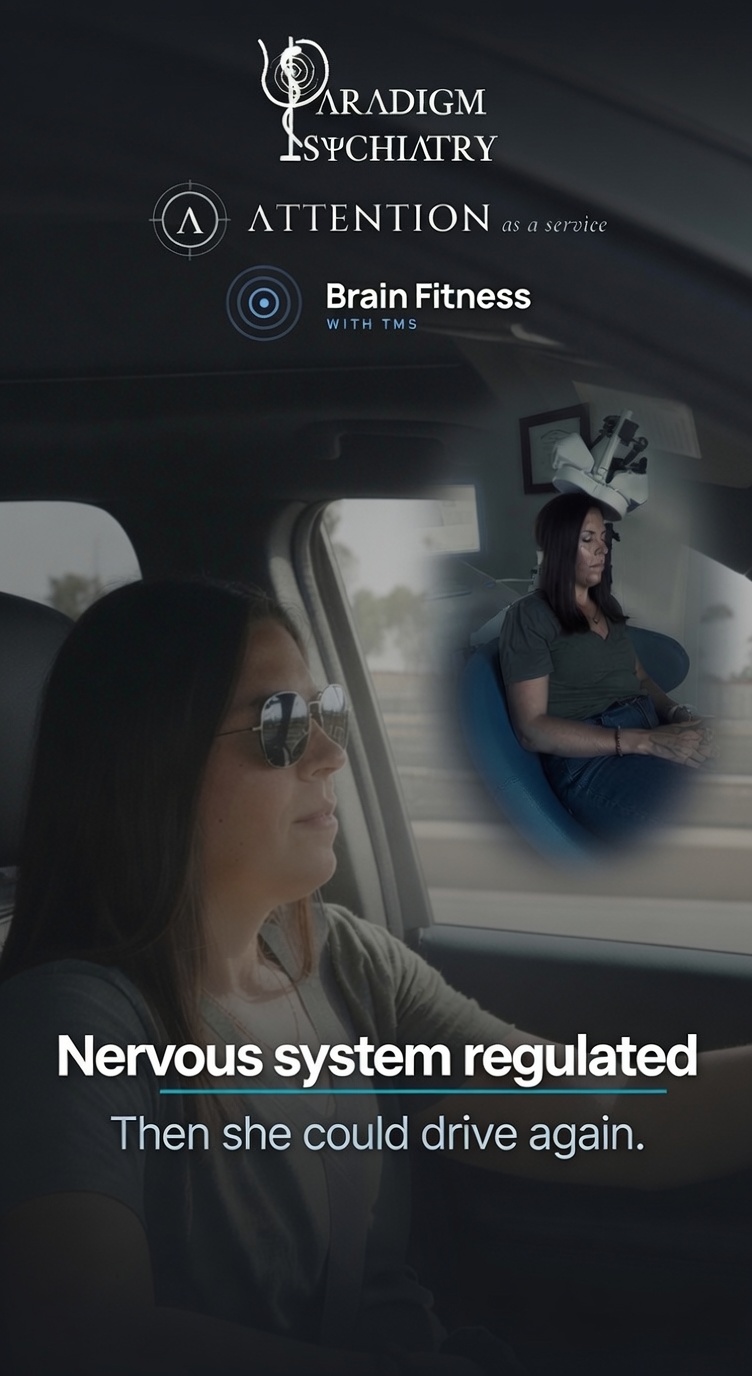
Nervous system regulated — then she could drive again. Attention-as-a-Service and Brain Fitness with TMS.

“I decided to add in TMS…night and day progress, so I was able to start driving on the freeway. My issue when driving I would have essentially a full blown panic attack. It helped me to actually calm my nervous system down. Even for daily life, I can prioritize things better. I’m not feeling scatterbrained and I have better systems in place and my sleep has improved.”

Attention-as-a-Service & Brain Fitness with TMS combined Driving-associated Anxiety & Nervous System regulation

Individual experience. Not a prediction of your results. No outcome is guaranteed.

About

Pranav M. Jagtap, MD, ABPN-certified psychiatrist. Published research on sustained attention; studying brain networks and brain stimulation since 2011. Over 5 years of clinical TMS experience. Founder, Paradigm Psychiatry.

  • ABPN-certified
  • Brain networks & stimulation since 2011
  • Published research on Sustained Attention
  • 5+ years clinical TMS

How we work

Highly personalized — not a stock protocol

This is not the multi-week insurance course used for treatment-resistant depression. Session length, frequency, and how long you continue are set for you after clinical evaluation — not copied from a coverage checklist.

  1. Evaluation first

  2. A plan designed for your system

  3. Schedule and duration set with you

  4. Painless. Non-invasive. Nothing enters the body.

Next step

Begin with an evaluation, not a decision.

A short conversation about whether this fits — not a commitment to a fixed course. Call, or send a note. We’ll respond with a clear path forward.

Paradigm Psychiatry
32611 Franklin Rd, Unit A
Franklin, MI 48025

If you are in crisis, call or text 988.

Intake form

I’m most interested in (select at least one)

We’ll receive your message at the clinic. Prefer a call? 947-209-5202