


9
questions on the PHQ-9, answered on this page. A score is not a diagnosis.
Kroenke, Spitzer, and Williams, 2001
National Depression Screening Day · Thursday, October 8
On Thursday, people everywhere will answer nine questions about their mood. The score can name a hard two weeks. It was not built to see the circuit underneath — stress that stays switched on, a memory system under load, and one thought that replays while better ones never stick.
If you might act on thoughts of suicide, call or text 988 or chat at 988lifeline.org. You do not need to finish this page first.
Thursday, October 8
National Depression Screening Day is the Thursday of Mental Illness Awareness Week. In 2026 that is October 8. The PHQ-9 is worth taking that day, and any day this month. A score is not a diagnosis.
Developed by Drs. Robert L. Spitzer, Janet B.W. Williams, Kurt Kroenke and colleagues. The PHQ-9 is in the public domain. Kroenke, Spitzer, and Williams, Journal of General Internal Medicine, 2001. Severity bands follow Kroenke and Spitzer, Psychiatric Annals, 2002. A score is not a diagnosis. Answers stay in this browser. They are not emailed and not added to a chart.
The score names a mood. The loop is what those nine questions were never built to see.
What the nine questions miss
The film’s account, held to what the literature can actually support. This is a pattern in the research. It is not a reading of your scan, and it is not true of every hard week.
01
In a share of people with depression, the daily cortisol rhythm does not fall the way a rested nervous system would predict — including into the night. That pattern is documented, and it is not universal. A chart in a film is not your lab result.
02
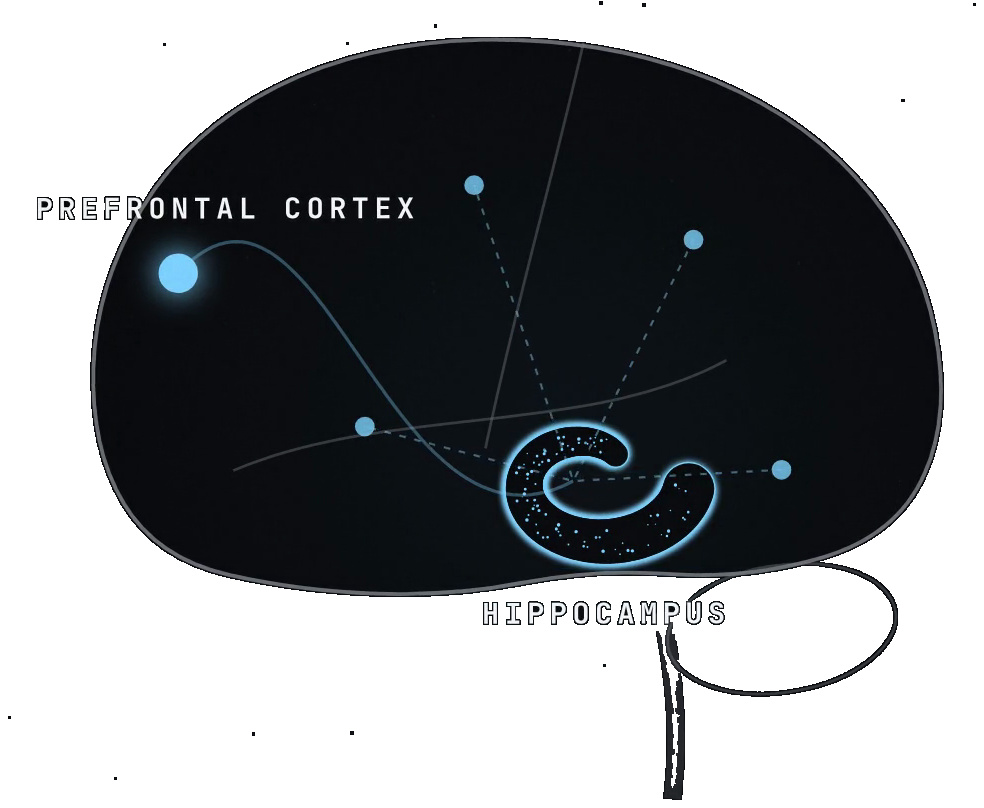
Memory and learning depend on it. Large imaging work, including the ENIGMA major-depression study, associates a smaller hippocampus more clearly with depression that has recurred than with a first episode. “Can” is the honest verb. The screen was not built to see that structure.
03
Focus slips. Recent memory goes patchy. Energy drains. The cruel part is functional: the prefrontal–hippocampal conversation you would use to imagine a different week is the one a single hopeless thought keeps occupying. Better thoughts try to land and don’t.
It was never weakness. It was the substrate.
What holds up
9
questions on the PHQ-9, answered on this page. A score is not a diagnosis.
Kroenke, Spitzer, and Williams, 2001
3 min
an intermittent theta-burst session in the THREE-D trial, non-inferior to a standard session of about 37 minutes for treatment-resistant depression.
Blumberger et al., The Lancet, 2018
2008
FDA clearance of TMS for major depression. Later clearances include OCD and anxious depression. Candidacy is still a clinical decision.
Not a clearance for every hard week
The circuit
Theta-burst stimulation patterns magnetic pulses on a theta rhythm and delivers them to the prefrontal cortex, which is connected into the memory and mood networks the film is talking about. That is the clinic’s frame for the instrument. It is not a promise that a structure grows back on a schedule.
Non-invasive magnetic pulses at the scalp. You stay awake. Seizure is a rare risk of TMS, not the goal of treatment. Medication decisions stay between you and your prescriber. Do not stop a medicine because of this page.
Most people describe temporary scalp sensation or a mild headache. The stimulation itself does not carry the weight, sexual, or fog profile of another antidepressant molecule. “Near-zero” on this site means that comparison — not “nothing ever happens.”
Response is tracked session by session. You are not left for two months wondering whether “this one” is doing anything. That is a difference in the process. It is not a guarantee of remission.
TMS is FDA-cleared for major depression, anxious depression, and OCD, inside clinical criteria. Insurance coverage usually requires medication trials that were not enough. If you are not a candidate, you will hear that.
TMS: Transcranial Magnetic Stimulation
TMS stimulation
Loading video…
Painless magnetic pulses. Awake. No new prescription to titrate.
Your physician
Pranav M. Jagtap, MD is an ABPN-certified psychiatrist. He has studied neuroimaging, brain networks, and brain stimulation since 2011, published research on Sustained Attention, and has 5+ years of clinical TMS experience at Paradigm Psychiatry.
Insurance TMS
Insurance TMS for depression typically requires more than one medication trial without adequate relief. If that is already your history, Thursday’s screen is not the start of the story — it may be the moment coverage becomes the practical question. We check that during intake. Brain Fitness with TMS remains the frame when insurance criteria are not.
Coverage depends on your plan and on clinical criteria. A screening-day score does not establish either.
Check during intakeNext step
Thursday, October 8, or any day after. Tell us what the last two weeks have felt like and what has already been tried. We’ll answer with a path — Insurance TMS when you qualify, another frame when you don’t, and a clear no when TMS is not the instrument.
Paradigm PsychiatryEducational information only — not medical advice and not a diagnosis. TMS candidacy requires clinical evaluation. Individual results vary. Never stop or change psychiatric medication without your prescriber. If you are in crisis, call or text 988.