

6 million
Americans over 65 have clinical depression
Brain Fitness with TMS | Paradigm Psychiatry

The flatness.
The fog.
The quiet.
Everyone files these under getting older. Almost nobody checks whether that's what they actually are.
Pranav M. Jagtap, MD · ABPN-certified psychiatrist
Brain Fitness Check
Try these two quick modules — a sustained Attention gauge and a Working Memory Challenge. Or scroll on and read further to see how this resonates with you.
Educational only — not a diagnosis. Both demos lean on front-of-brain circuits and take about a minute or two together.
A ~30-second continuous performance snapshot (with an option to sustain to 60 seconds if you’re holding well). Press space (or tap) only when you see X. Ignore every other letter.
Educational only — not a medical diagnosis or clinical CPT substitute. Results reflect this moment (sleep, stress, and environment all matter). No email required to start — after the run you’ll see a qualitative read; email unlocks the full report on this page.
Get ready…
Checkpoint
Sustain?
Strong hit rate. Hold to 60s, or bank the 30s run.
S sustain · F finish
You can respond until the next letter appears — space or tap only for X
Your run · qualitative read
—
Unlock your complete attention profile
Hit rates, reaction time, variability, omissions, commissions, and a short curated summary — unlocked on this page. Educational only, not a diagnosis.
Please enter a valid email to unlock your full report.
Full report
Targets you caught
% of X trials detected
Missed targets
False alarms
Avg. response speed
Std. dev. of hits
Hits + correct holds
Time-on-task
If you’d like a copy of this report, or want to follow up on what it means for brain fitness, you’re invited to reach out below.
Not a diagnosis — a snapshot of your Attention in this moment (sleep, stress, and setting all matter).
A short sequence-span check (~60–90 seconds). Watch the digits, then reproduce them in order using the large on-screen pad. Starts easy and steps up gently.
Educational only — not a clinical memory test or diagnosis. Results reflect this moment (sleep, stress, and environment all matter). No email required to start — after the run you’ll see a qualitative read; email unlocks the full summary on this page.
Get ready…
Remember the sequence — it will clear shortly
Your run · qualitative read
—
Want a short summary of your results + what they mean for brain fitness?
Max span, accuracy, and a plain-language framing of working-memory networks — unlocked on this page. Educational only, not a diagnosis.
Please enter a valid email to unlock your full summary.
Full summary
Longest correct sequence
Trials fully correct
Out of five
Sharp everyday function
It was never age alone. See how targeted stimulation works on these same networks — or take the next step with a short conversation.
Not a diagnosis — a snapshot of working memory in this moment (sleep, stress, and setting all matter). Lower scores mean networks can run less efficiently — not that the person is “gone.”
The misfiling

It looks like tiredness. Trouble concentrating. Forgetting names. Moving slower. Losing interest in things that used to be automatic.
It looks exactly like what everyone expects aging to look like.
So it gets explained instead of examined. Six million Americans over 65 have clinical depression. About one in ten is treated for it.
6 million
Americans over 65 have clinical depression
~1 in 10
of them is treated for it
That's not a failure of effort. It's a misread.
What this is really about
Nobody at seventy-nine is trying to optimize anything.
What people want back is smaller and bigger than that:



That isn't a symptom score. That's a person.
What TMS is
Focused magnetic pulses to the front of the brain. You sit in a chair, awake, about twenty minutes. No anesthesia. You drive yourself home.
Nothing enters the body — so there's nothing to interact with what you're already taking.
That last part is the whole reason this option exists for people on a long medication list.
TMS: Transcranial Magnetic Stimulation
TMS stimulation
Loading video…
Focused magnetic pulses to the front of the brain. You sit awake; nothing enters the body.
Straight talk
TMS is not a cure-all and not a memory treatment for dementia or Alzheimer’s. For depression in later life, it can help restore usable capacity — presence, interest, follow-through — so day-to-day life feels more like you again.
It works best as part of a fuller picture: sleep, movement, food, and real social connection. When those are supported, the same nervous system has more room to respond. Age is not a disqualifier. Not everyone is a candidate. We are out of network; costs are given in writing before anything starts.
From people who've been here
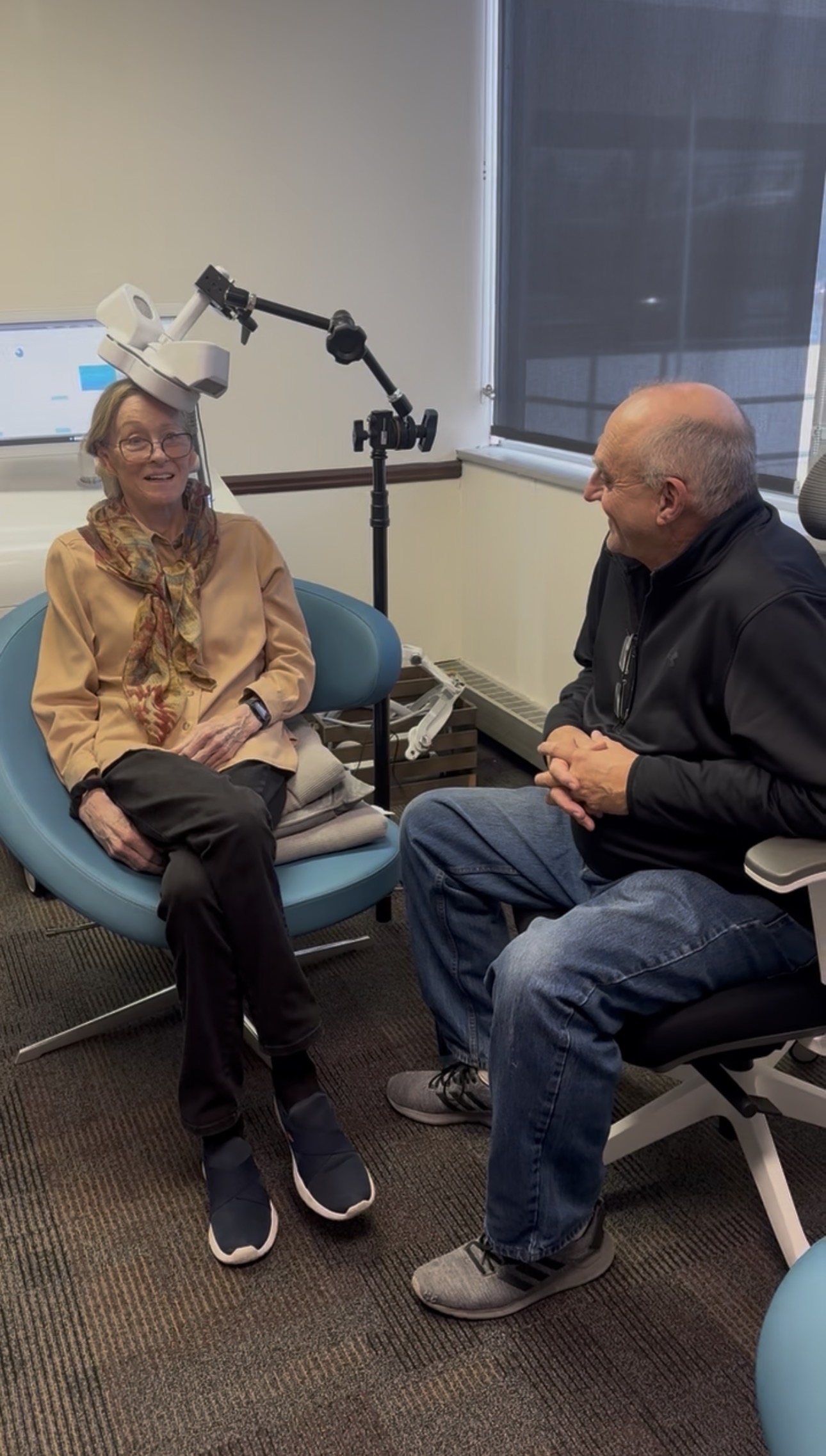
“We had two quick sessions, 11 minutes long each. Sue went to get a drink of water down the hall…and immediately we could see her stride was totally different. The shuffling was all but gone, and we looked at each other in amazement. We find after each session…the verbalization and clarity of storytelling is much stronger. The joking, the sense of humor has come back. The joking and the smile. All positive things.”
Individual results vary. Not everyone responds.
Dr. Jagtap has studied brain networks and brain stimulation since 2011, published research on sustained attention, and has over five years of clinical TMS experience.
Out of network
Insurance coverage for TMS generally requires documented failed antidepressant trials. Which means: before it's covered, you have to add more drugs, and have them not work.
For someone already taking seven things, that's the wrong direction.
Out of network means the protocol is set by a physician looking at you — not by a coverage policy deciding what you've earned.
Adult children
You noticed before they did.
The hard question — depression, or the beginning of something else — is answerable. Answering it is the first appointment, not the last.
Bring: the full medication list. When the change started. What they stopped doing first.
You can call for them. 947-209-5202

One call
Call. A person answers. You'll get an evaluation with Dr. Jagtap, a clear answer about whether TMS fits, and the cost in writing.
If it doesn't fit, you'll leave knowing what to do instead.
Educational information only — not medical advice. TMS candidacy requires clinical evaluation. Individual results vary. TMS is not FDA-cleared for dementia, Alzheimer's disease, or age-related cognitive decline. Paradigm Psychiatry is out of network and does not bill Medicare.
Or send a note
Prefer not to call first? Leave a note. We'll respond with a clear next step.
Paradigm Psychiatry